
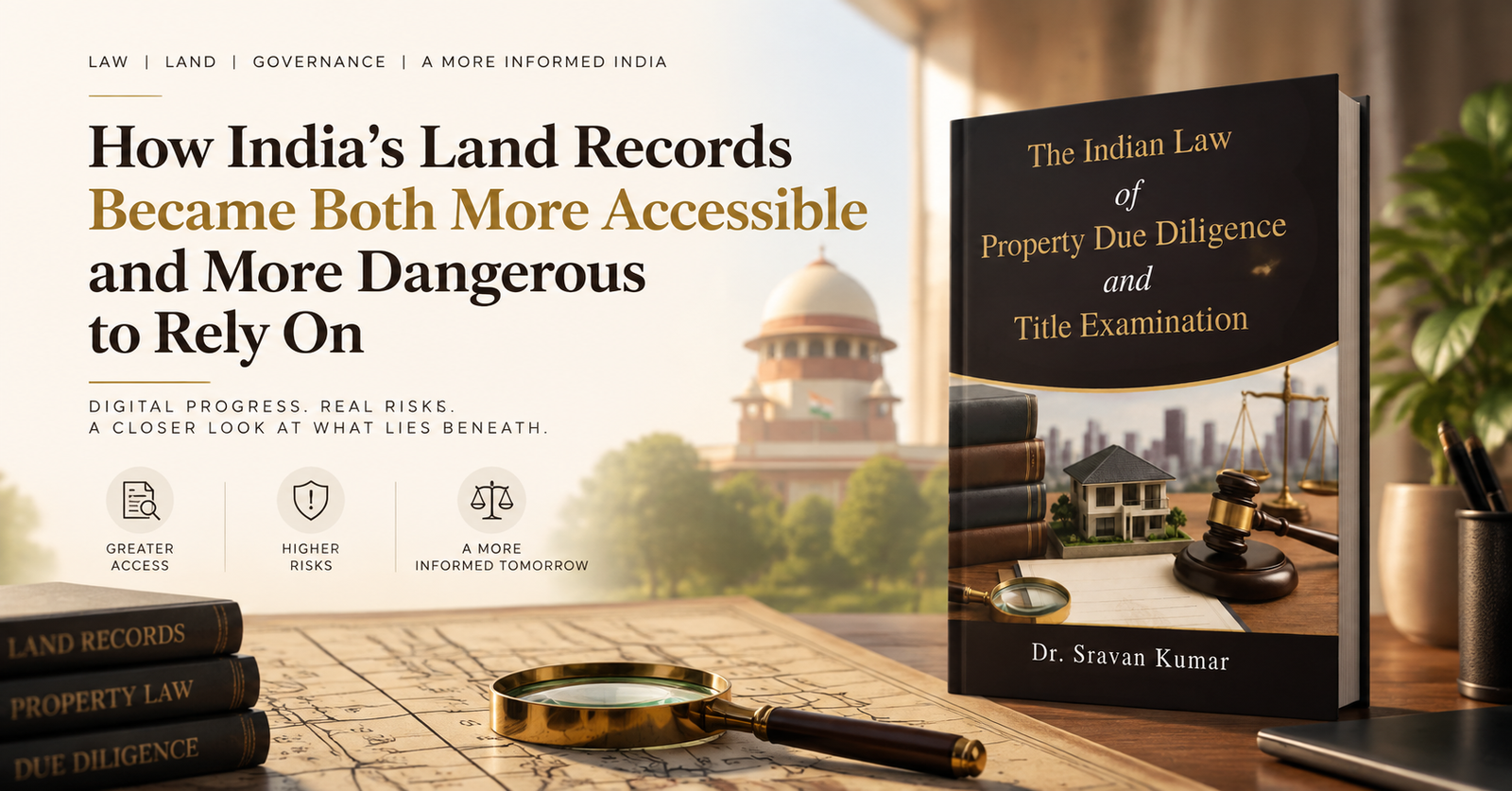
The Government of India’s Digital India Land Records Modernisation Programme has made property records more accessible than they have ever been. In many states, a person can view ownership details, survey records, and mutation history through an online portal within minutes.
This accessibility creates a specific danger that Dr. Sravan Kumar, author of The Indian Law of Property Due Diligence and Title Examination, addresses directly in his discussion of evidence law and public records.
Digital availability does not confirm legal accuracy.
What digitisation has and has not changed:
Pre-existing errors in land records have been digitised along with accurate information. A mutation entry that incorrectly recorded ownership in 1978 appears in the digital record as confidently as an accurate one. A revenue record that was fraudulently altered before digitisation carries the digital presentation of official data.
The examining practitioner must work with records as they exist, identifying inconsistencies between the digital records, the physical documents in the title file, the registered instruments at the Sub-Registrar’s office, and the other public records relevant to the specific property.
The presence of a name in a digital land record is not evidence that that person holds legal title. It is evidence that the revenue administration has recorded that name in its register. The legal analysis of what that recording means, how it arose, whether it is consistent with the registered instrument record, and whether it corresponds to the title chain established through proper document examination, requires legal training and structured methodology that a database search alone cannot provide.
What the DILRMP has achieved and where limitations remain:
The DILRMP aims at land records digitisation, survey and resurvey of boundaries, and computerisation of registration. Its implementation has been uneven across states. Some states have made significant progress towards integrated land record systems. Others have digitised records that contain substantial errors from the manual record period.
The convergence of digital land records, digitised registration records, and CERSAI searches into a genuinely integrated verification system remains an aspiration rather than a current reality across India. Until that integration is complete, the structured five-dimension due diligence methodology that Dr. Sravan Kumar presents in this book remains the professional standard for safe property verification.
The Indian Law of Property Due Diligence and Title Examination by Dr. Sravan Kumar is available on Amazon, Flipkart, Kindle, and Google Books. Buy now and understand what digital land records can and cannot tell you about the property you are considering.
Grab your copy now: https://amzn.in/d/04PLZ83H

